





Western Kenya wins big as TATU University gets historic approval unlocking new era for hidden talent

Kenyans with diverse talents have received a major boost after the government granted The African Talent University (TATU) a Letter of Interim Authority (LIA) after the Commission for University Education (CUE) gave its approval after decades of painful wait.
This move by the government paves the way for the institution to begin admitting students and opening their world in talent nurturing.
During the colourful event presided over by Education Cabinet Secretary Migos Ogamba on Monday, April 20, it was evident it was an important step towards building an inclusive university system that serves all learners.
Ogamba noted that the recognition reflects the government’s commitment to expanding access to higher education while aligning learning with modern economic realities.

He added that Kenya continues to face rising demand for university education, with only a fraction of secondary school leavers progressing to universities each year.
CS Ogamba noted that TATU university will be of great impact in the country’s CBC system.
He said the University will keep the country’s education aligned with the system and the government’s agenda.
“As we grant this Letter of Interim Authority, we are responding to a very real and growing demand for university education in our country. Each year, over 900,000 candidates sits for their KCSE exams yet a fraction of that number, approximately 28% or so, transition into universities that can fully nurture their talents and aspirations,” the CS said.
The PS for Higher Education Dr Beatrice Inyangala and officials from the CUE were present during the event.
On his part, the institution’s founder, Professor Humphrey Oborah said that the university is revolutionary in the country’s education sector.
According to Oborah, the university comes in at an opportune time where it will be instrumental in addressing some of the gaps noted in the Competency Based Education (CBE) where skills are emphasised.
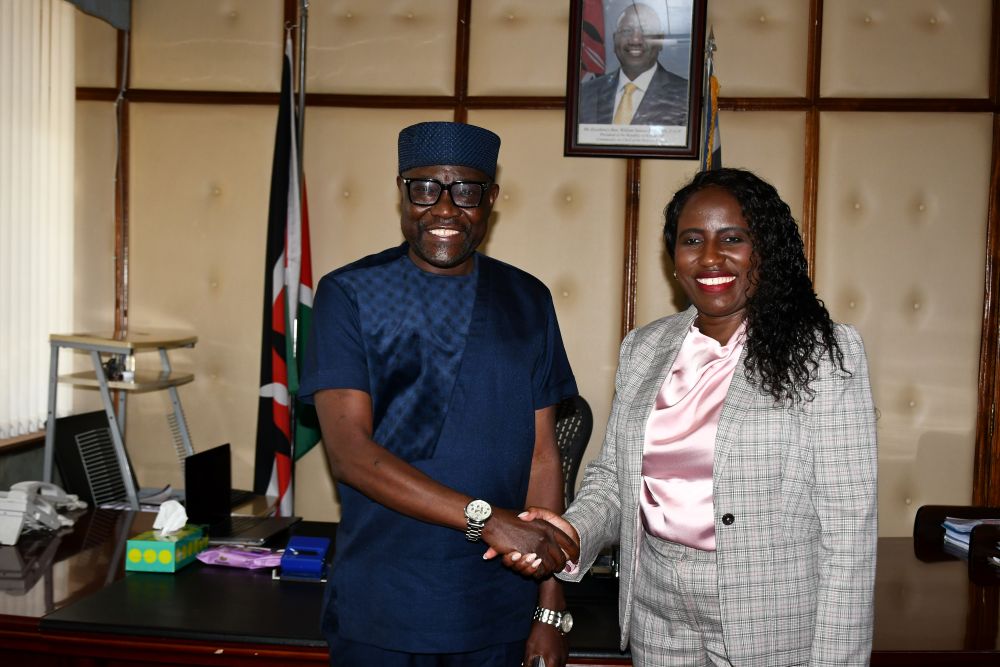
Professor Oborah believes that children should not be judged by the grades they get in classrooms.
“We want to make sure that children are not judged by mere grades, that people with innate and pure potentials are also equally accepted and can be able to be seen to be capable,” noted Prof Oborah during the event.
Prof Oborah, an educator, thinker, and visionary who believes that Africa needs a fundamentally different education system, one that recognises and develops the natural abilities and talents inherent in every human being.
For many years, Prof. Oborah had been deeply troubled by the limitations of conventional education systems.
Traditional models, he believed, measured intelligence too narrowly through standardised examinations while ignoring vast forms of human capability, creativity, practical intelligence, artistic expression, innovation, leadership, and entrepreneurial ability.
He developed the ground breaking concept known as Talent Based Learning (TBL) using Modern Human Metrics Technology, an educational philosophy that combines biological, psychological, and social attributes to better understand how individuals learn and how their talents can be developed.
It is this philosophy that has seen TATU university opening its doors to thousands of Kenyans thirsty for higher education.

Based in Kisumu, TATU is positioning itself as a unique centre of learning by focusing on talent-driven and non-traditional education pathways.
The institution aims to nurture students whose strengths may lie beyond conventional academic models, helping transform skills and creativity into professional success.
The establishment of TATU isa blessing to the larger western Kenya which is touted as one of the greatest harbours of raw talent.
It is expected to open new opportunities for the region’s residents as well as other counties.
TATU become the 85th university in the country and the only talent-based institution of higher learning.
Prof Oborah and the university are now expected to establish a governing body, mobilise academic resources and develop acceptable physical infrastructure.
In Kenya, after receiving a Letter of Interim Authority (LIA), a new university must establish its governing body, develop physical infrastructure, and assemble academic resources while operating under supervision of the Commission of University Education.