





Supreme Court Deals EACC, ARA major blow with landmark ruling on asset forfeiture
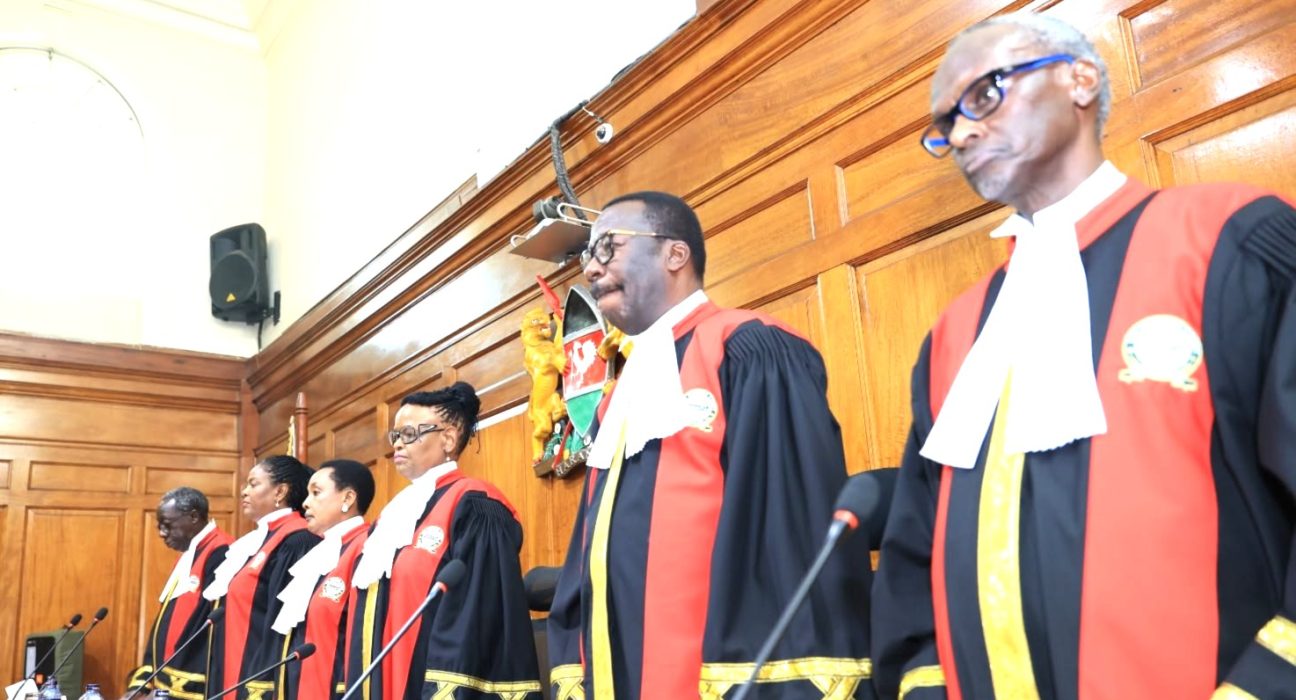
In a landmark decision delivered today, the Supreme Court of Kenya has dismissed appeals by the Ethics and Anti-Corruption Commission (EACC) and the Assets Recovery Agency (ARA), drawing a strict legal line on how state agencies can seize and forfeit citizens’ wealth.
The apex court ruled that anti-graft agencies cannot simply demand civil forfeiture of assets under the Proceeds of Crime and Money Laundering Act (POCAMLA) without establishing a direct link or “nexus” between the targeted funds and a specific criminal activity.
The ruling, which upheld a prior decision by the Court of Appeal, directly shields individuals from arbitrary state deprivation of property based purely on suspicion or unexplained large bank balances.
The high-stakes legal battle stemmed from a 2017 case where the ARA and EACC targeted Ksh19,688,152.35 held in three Equity Bank accounts belonging to a businesswoman, Pamela Aboo.
The state agencies suspected the funds were the proceeds of corruption, alleging that her husband, Alex Mukhwana Khisa,then an employee of the Kenya Revenue Authority (KRA) had used her accounts as a conduit for bribes.
While the High Court initially allowed the forfeiture of the millions, the Court of Appeal overturned the decision, prompting the EACC and ARA to move to the Supreme Court.
Throughout this gruelling legal battle, Pamela Aboo was represented by Oringe and Company Advocates, who successfully navigated the appellate system to secure her victory
A five-judge bench comprising Chief Justice Martha Koome, alongside Supreme Court Justices Smokin Wanjala, Njoki Ndungu, Isaac Lenaola, and William Ouko, unanimously ruled that POCAMLA demands a clear evidentiary threshold that the state cannot bypass.
The bench noted that while the law provides for distinct asset recovery frameworks, state agencies had conflated the rules by failing to conduct thorough investigations. Writing for the Court, the judges clarified:
“The incidence of crime remains central to such forfeiture proceedings… It is therefore a requirement that the ARA has to establish a nexus between the subject matter of forfeiture and a crime or its intended commission when seeking an order of forfeiture.”
The judges distinguished POCAMLA from the Anti-Corruption and Economic Crimes Act (ACECA), noting that while ACECA allows the EACC to recover “unexplained wealth” based on disproportionality to a suspect’s known income, POCAMLA holds a stricter standard.
“In the former [ACECA], all that is required to raise a rebuttable assumption of corrupt conduct is the disproportionality, while in the latter [POCAMLA], the nexus between the property which is the subject of forfeiture proceedings and the incidence of crime cannot be dispensed with.”
The Supreme Court heavily criticized the ARA for failing to properly investigate Aboo’s explanations. When questioned, Aboo had stated that the millions were legitimate earnings from her small-scale businesses in transportation, cereals, and perfumes across Mombasa and Busia.
Instead of actively disproving her business claims, the ARA merely argued that she had not provided receipts.
Furthermore, the Supreme Court pointed out a glaring procedural error: the state agencies failed to join Aboo’s husband, the alleged source of the bribe money to the lawsuit.
“Where the Agency’s case rests on the assertion that the property constitutes proceeds of crime generated by a third party and merely held, concealed, or enjoyed through the respondent, the alleged perpetrator of the predicate offence possesses a direct and substantial interest in the proceedings.”
Dismissing the consolidated appeals with costs heavily awarded against the EACC and the ARA, the Supreme Court ordered that the long-running freeze on Aboo’s bank accounts be lifted.
The judgment sets a massive legal precedent, signaling to state investigators that the burden of proof in civil asset forfeiture remains firmly on the state, and that “poor and disjointed investigations” will no longer suffice to seize funds from Kenyan citizens.