
Raila’s handshakes: How one man turned rivalry into reconciliation, saving Kenya from turbulent times
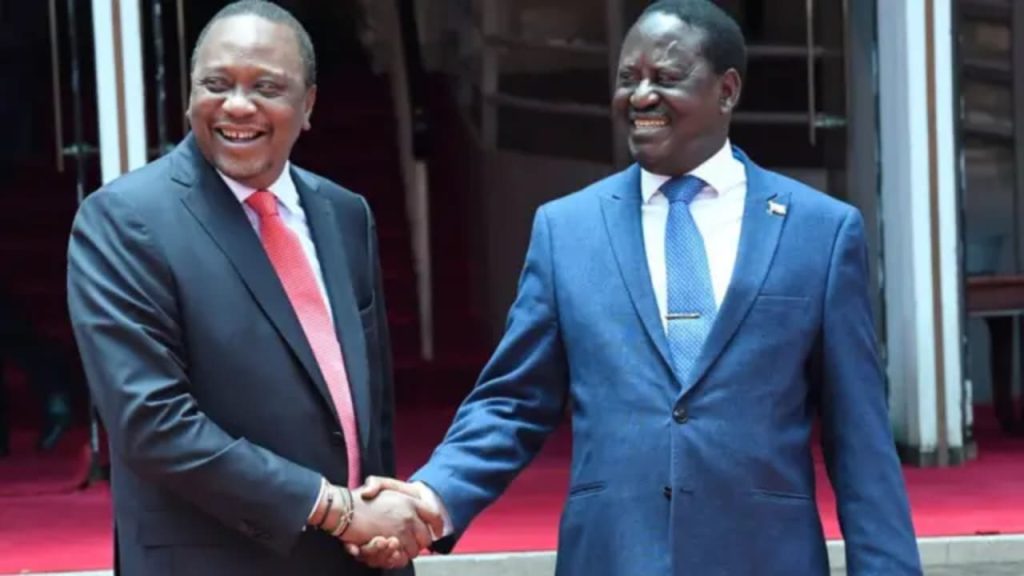
When the cameras flashed at the steps of Harambee House on March 9, 2018, the image seemed almost unbelievable. There stood Raila Amolo Odinga, the perennial opposition leader who had once called the government “illegitimate,” smiling beside President Uhuru Kenyatta, the man he had accused of stealing an election.
Their handshake lasted only seconds, but its echoes would reshape Kenya’s politics and reaffirm a lifelong philosophy that Raila Odinga has practiced for decades peace over pride, dialogue over destruction.
It was not the first time he had extended such a hand and perhaps not the last.
For more than half a century, through imprisonment, exile, and electoral defeat, Raila has mastered the art of turning confrontation into conversation.
From his uneasy coalition with Mwai Kibaki in 2008 to his measured cooperation with William Ruto’s government today, the politics of the handshake has become both Raila’s signature and Kenya’s survival code.
To understand the handshake, one must return to 2007 a year that pushed Kenya to the brink. That December, after one of the most fiercely contested elections in the country’s history, the Electoral Commission declared President Kibaki the winner.
Raila Odinga’s supporters erupted in disbelief. What followed was carnage: over 1,100 people killed, half a million displaced, and a nation divided along ethnic lines.
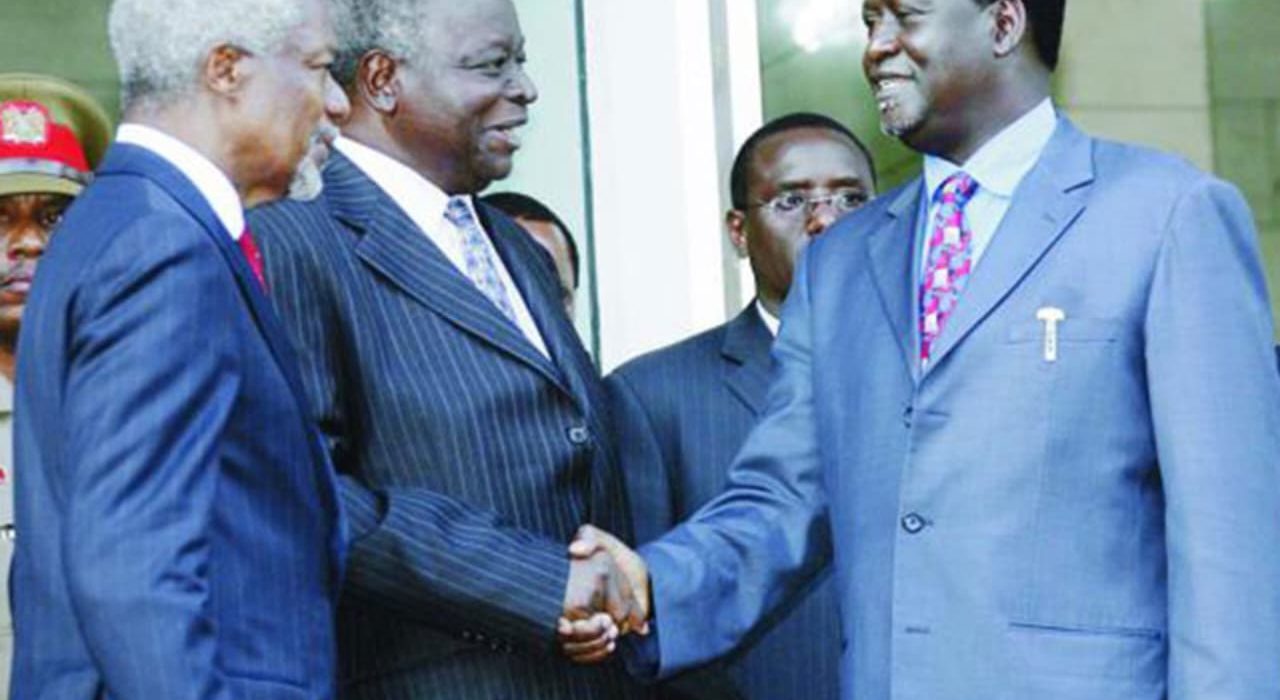
Then, under international mediation led by Kofi Annan, the rivals met. Cameras captured the moment Kibaki and Raila shaking hands across a conference table, their faces stiff, their eyes tired.
Out of that fragile gesture was born the Grand Coalition Government, with Raila sworn in as Prime Minister and Kibaki retaining the presidency.
It was not love, but necessity.
Raila would later call it “a painful but patriotic compromise.” The two men, bound by crisis, governed together for five years.
That uneasy partnership birthed one of the country’s most transformative documents the 2010 Constitution, which devolved power, guaranteed rights, and anchored Kenya’s democracy more firmly than ever before.
“We chose peace over pride,” Raila told a rally years later. “Because sometimes, saving a nation is greater than saving a name.”
A decade later, history repeated itself.
In 2017, Kenya once again descended into political paralysis. The Supreme Court annulled the presidential election a first in Africa after Raila’s challenge.
The rerun, which he boycotted, handed Uhuru Kenyatta a disputed victory. The country teetered on the edge of unrest.
Then, without warning, came another handshake Under the blistering Nairobi sun, Raila and Uhuru clasped hands on the steps of Harambee House. No mediators. No Kofi Annan. No prior leaks. Just two men, long-time rivals, deciding that peace was worth another gamble.
That moment birthed the Building Bridges Initiative (BBI) a project that sought to heal Kenya’s wounds by reimagining its political architecture. The initiative promised inclusivity, equity, and the end of divisive winner-takes-all elections.
It ignited national debate, inspired hope, and provoked controversy in equal measure.
Though later nullified by the courts, BBI had already changed the tone of Kenyan politics. The violence that had marked previous elections gave way, for once, to dialogue.
The markets steadied. The rallies softened. The handshake, however criticized, had worked For Raila, it was vindication For Uhuru, redemption And for Kenya, a reprieve.
Yet the handshake also exposed the paradox that defines Raila Odinga.
For his admirers, it was the act of a statesman who understood that unity must precede ambition.
For his critics, it was the surrender of an opposition that had promised revolution but settled for reconciliation.
In truth, both are right Raila’s politics has always been a dance between power and principle. From the moment he first entered Parliament in 1992 to his fifth presidential bid in 2022, he has carried the contradictions of a man both inside and outside the system the dissident who keeps saving the state.
The 2018 handshake also reshaped Kenya’s power dynamics It drove a wedge between President Kenyatta and his then-Deputy, William Ruto, who accused the duo of plotting his downfall.
As Raila grew closer to Uhuru, Ruto reinvented himself as the outsider —l the voice of Kenya’s “hustler nation.”
The alliances shifted, the slogans changed, but the script remained Raila’s: the idea that politics could bend toward peace.
Handshakes may heal nations, but they rarely heal politics Many of Raila’s supporters, especially the youth who saw him as the symbol of resistance, felt betrayed. They accused him of co-optation of trading fire for favor. He dismissed the claims with characteristic calm
“Reform is not rebellion,” he said. “It is the courage to negotiate for the people who cannot be at the table.”
The truth lies somewhere between cynicism and idealism, In a region where electoral disputes often end in bloodshed, Raila’s willingness to shake hands with his rivals has kept Kenya from imploding.
His critics call it elite accommodation; his defenders call it democratic maturity.
Either way, the effect is undeniable for two decades, Kenya has avoided the civil wars that have fractured other African nations in moments of political tension.
By the time William Ruto rose to power in 2022, the political tables had turned again.
Raila now backed by Uhuru lost narrowly in an election he described as “opaque and compromised.” Yet unlike previous years, he chose restraint over rebellion.
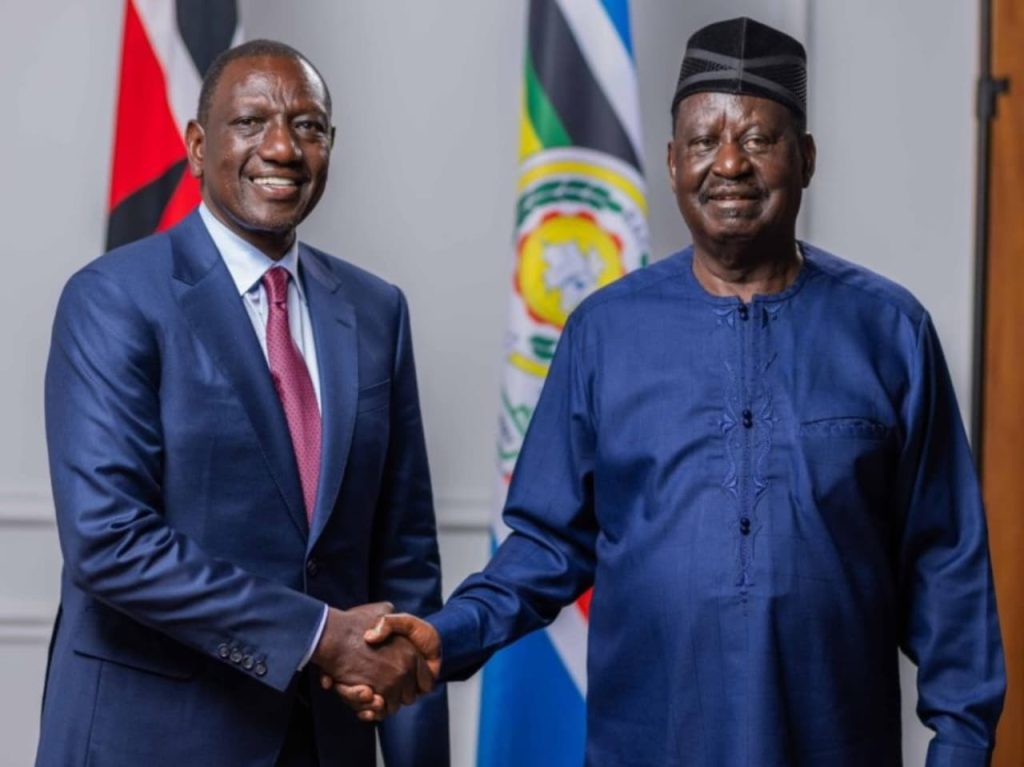
There were no burning tyres, no barricades, no descent into chaos.In 2023, when President Ruto invited him for bipartisan dialogue, Raila accepted. The two men once fierce adversaries met under the National Dialogue Committee at Bomas of Kenya, trading policy notes instead of insults.
It was the third great handshake of Raila’s career, less theatrical but equally significant From Kibaki to Uhuru to Ruto, his philosophy has remained constant: when the nation bleeds, shake hands first, argue later.
The Man Behind the Gesture To many Kenyans, Raila Odinga is both myth and man a political veteran who has suffered detention, exile, and defeat but remains unbowed.
He is as polarizing as he is respected, a man whose resilience borders on legend. Born in 1945 in Maseno, the son of Jaramogi Oginga Odinga, Kenya’s first Vice President, Raila inherited a legacy of dissent.
He was detained for six years under Moi’s dictatorship, accused of plotting a coup. In prison, he learned the discipline of silence; in exile, the patience of diplomacy.
Those lessons shaped the man who, decades later, could sit across the table from his tormentors and still call them partners, He often quotes Galatians 6:9
“Let us not become weary in doing good.” For him, politics is not an end but an act of endurance.
The “handshake” is more than a political event; it is Raila Odinga’s creed.He believes that Kenya’s problems ethnic division, inequality, and cyclical violence can only be solved through inclusion.
His detractors see weakness; his admirers, wisdom, But history tends to favor the peacemakers.
The philosopher Reinhold Niebuhr once wrote, “Man’s capacity for justice makes democracy possible; but man’s inclination to injustice makes democracy necessary.”
In Raila’s case, that paradox has been his life’s work to demand justice while preventing injustice from consuming the nation.
Today, as he steps into the twilight of his political career, Raila’s influence extends beyond Kenya’s borders.As African Union High Representative for Infrastructure Development, he championed regional integration, calling for a pan-African railway and shared power grids.
In 2025, he was dispatched as a special envoy to mediate peace talks in South Sudan a testament to the trust even his rivals place in his moral authority.
From a prisoner of conscience to a continental diplomat, Raila Odinga has become something rare in African politics: a man trusted by enemies and respected by friends.
Raila Odinga has lost more elections than any major African leader of his generation.
He has seen his victories questioned, his supporters persecuted, and his dreams deferred.
Yet he has never turned bitterness into vengeance.Each time he was betrayed, he offered a handshake Each time he was mocked, he offered patience.
Kenya’s democracy flawed, loud, and vibrant owes much of its endurance to that stubborn decency.
The irony is that Raila may never sit in State House, but the presidents who did have all needed his hand to steady their own reigns.
He has shaken hands with history and, perhaps, shaped it in the process.
There are few images in modern Kenyan politics as enduring as that of Raila Odinga shaking hands with his rivals Kibaki, Uhuru, Ruto each gesture bridging not just political chasms, but the fault lines of a fragile nation.
In those moments, the son of Jaramogi becomes more than a politician He becomes a mirror of Kenya itself: wounded, resilient, always reaching forward.
In a continent where grudges often last longer than governments, his open hand remains a quiet revolution a reminder that sometimes, the bravest act in politics is not to fight, but to forgive.